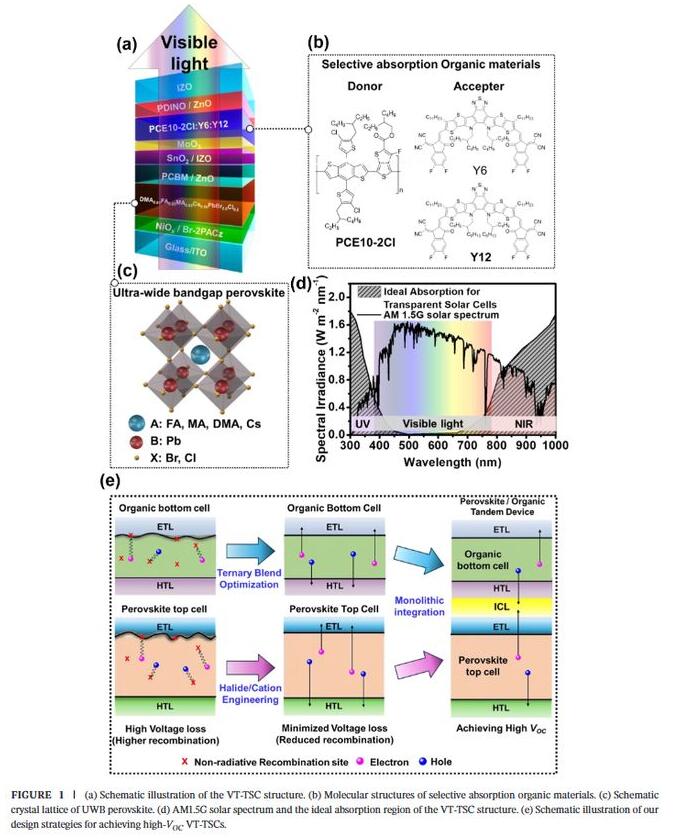
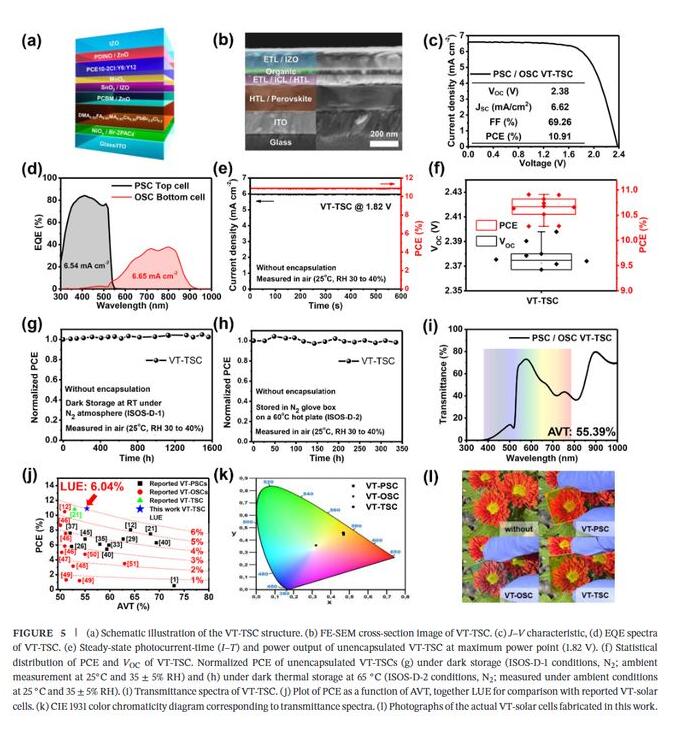
In this article, Seo Jin Ko from Gyeongbuk Institute of Science and Technology in Daegu, South Korea, and Dong Won Kang from Chung Ang University, South Korea, reported a selective absorption, single-chip integrated perovskite /organic stacked solar cell that successfully decouples visible light transmittance from photocurrent and effectively reduces voltage loss, achieving the highest light utilization efficiency among visible light transparent stacked devices currently available.
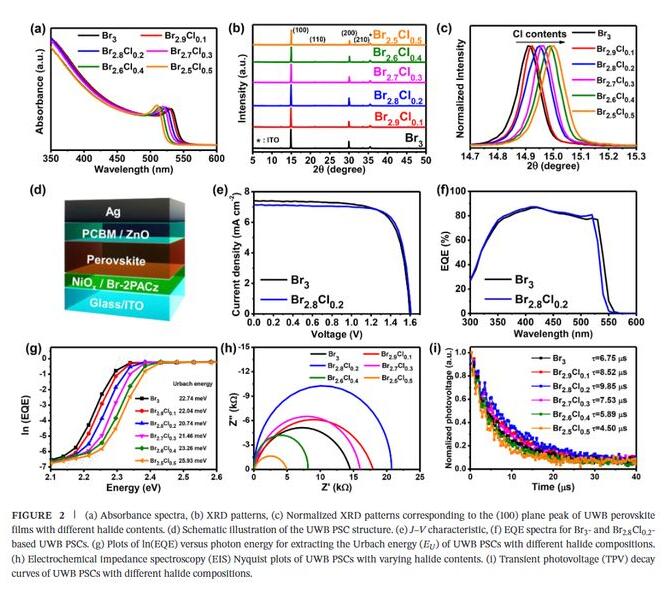
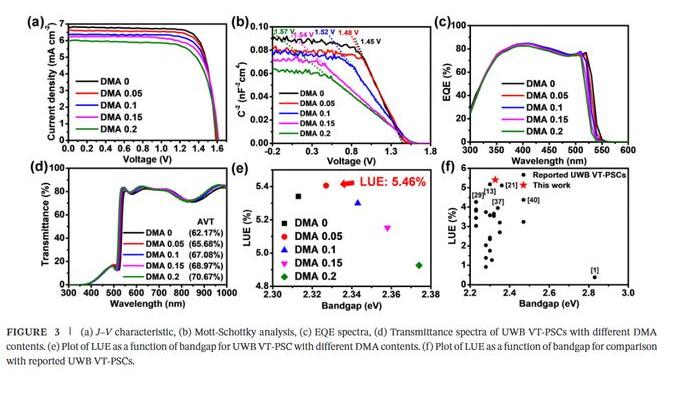
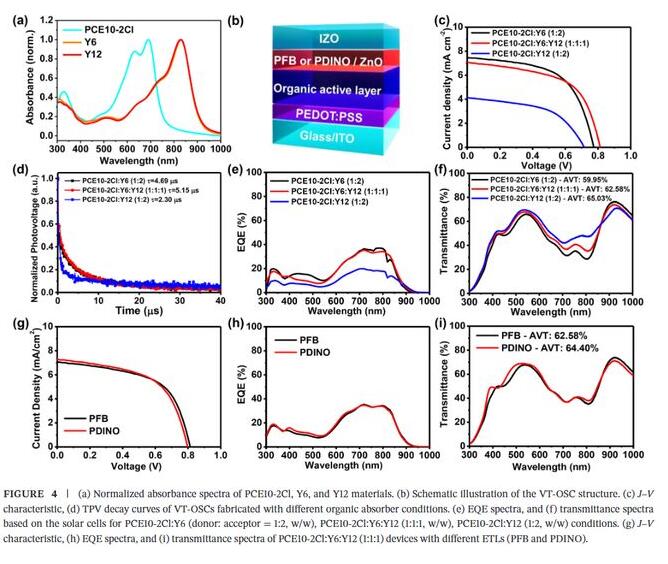
The top adopts a DMA alloyed perovskite sub cell with ultra wide bandgap (about 2.34 eV), which mainly absorbs light with wavelengths below about 530 nm. Its single junction device achieves an average visible light transmittance of 65.68% and a power conversion efficiency of 8.23%, corresponding to a light utilization efficiency of 5.46%. The bottom adopts a ternary system PCE10-2Cl: Y6: Y12 organic stack, which efficiently absorbs light in the near-infrared region while minimizing visible light absorption. The final stacked device achieved a power conversion efficiency of 10.91% at an average visible light transmittance of 55.39%, corresponding to a light utilization efficiency of 6.04%.
This is currently the first visible light transparent perovskite/organic stacked device with a light utilization efficiency exceeding 6% under AVT ≥ 50% conditions, and has set a record for the highest open circuit voltage of 2.38 V.
Research Highlights:
Breaking the threshold of 6% light utilization efficiency for the first time: Under the condition of an average visible light transmittance of ≥ 50%, achieving a light utilization efficiency exceeding 6% for the first time, providing a new performance benchmark for transparent photovoltaic window materials.
Ultra high open circuit voltage of 2.38 V: setting a record for the highest open circuit voltage of perovskite/organic stacked devices, significantly reducing voltage loss and improving overall output performance.
Spectral complementary design and low loss interface engineering: Through the design of ultra wide bandgap perovskite absorbing ultraviolet light and organic ternary system absorbing near-infrared light, the synergistic optimization of high transmittance in the visible light region and efficient power generation in the ultraviolet near-infrared region is achieved.
J. Ryu, S. Lee, U.-H. Lee, et al. “ Visibly Transparent Monolithic Perovskite/Organic Tandem Solar Cells Achieving Over 6% Light-Utilization Efficiency.” Advanced Materials (2025): e20278.
 E-mail: info@chemborun.com
 Tel: +86-574-87178138
  No. 1558, Jiangnan Road,, Ningbo, Zhejiang, China (Mainland)/31