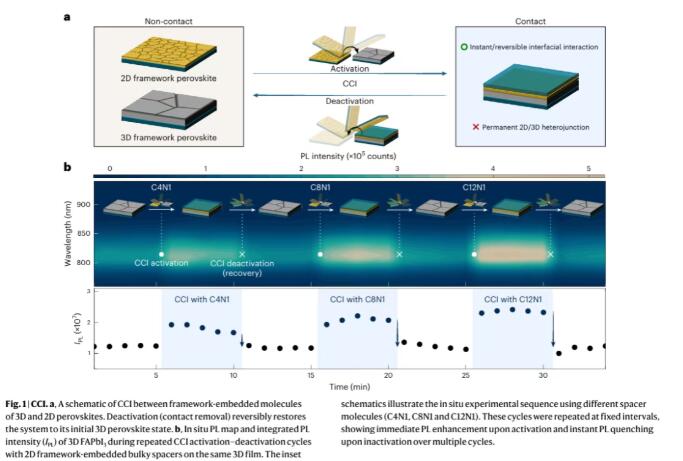
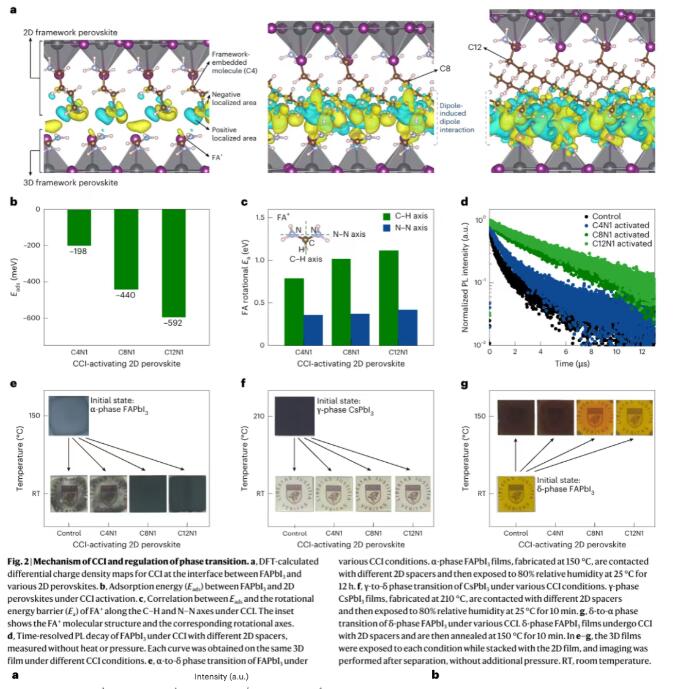
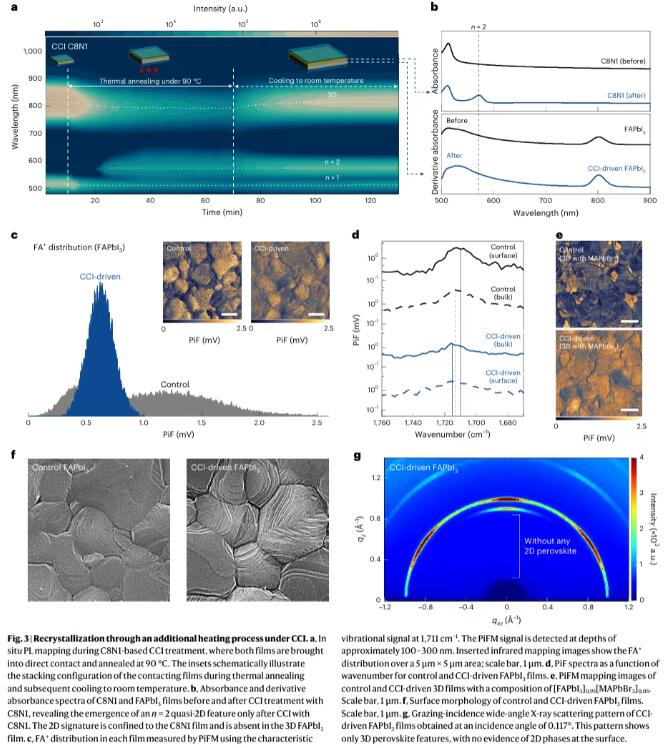
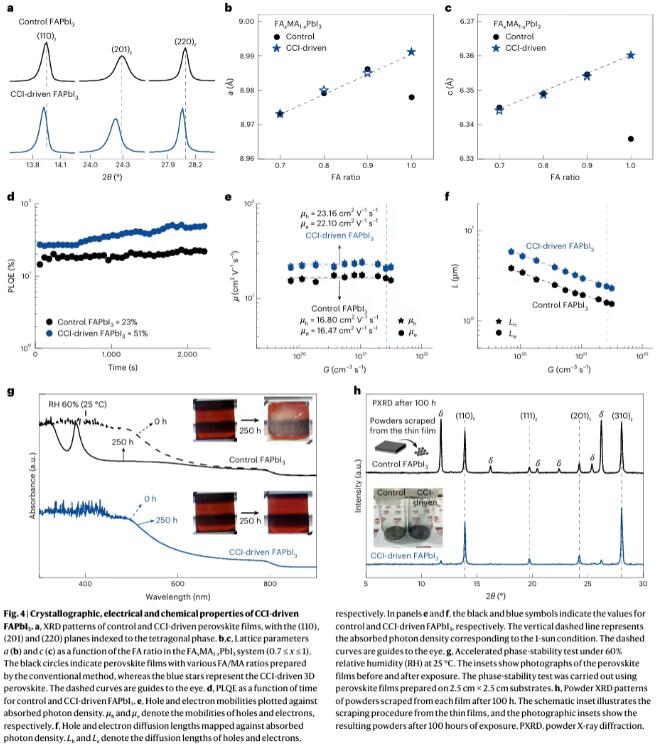
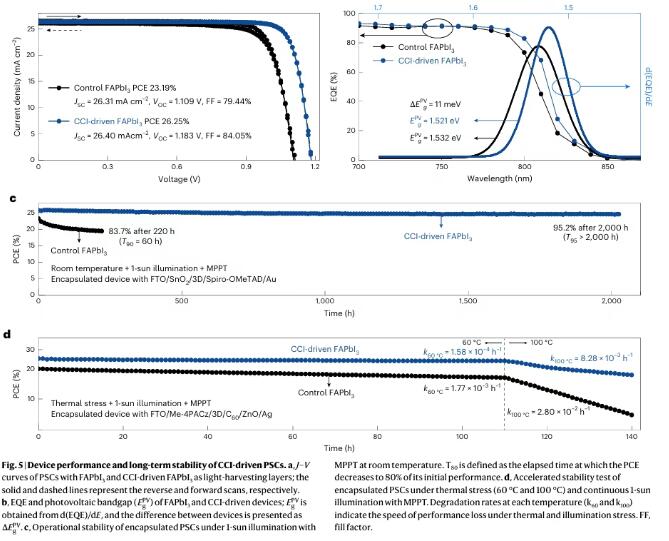
Molecular interactions are crucial for enhancing the efficiency and stability of perovskite solar cells; however, current solution-based approaches—such as molecular doping or surface passivation—suffer from inherent limitations in independently modulating these interactions. Here, Jun Hong Noh and colleagues at the Korea Institute of Science and Technology (KIST) unveil an intrinsic interfacial interaction arising from the simple contact between independently crystallized two-dimensional (2D) and three-dimensional (3D) perovskites, without the need for mixing or permanent bonding. We define this phenomenon as Contact-Triggered Cationic Interaction (CCI); it reversibly constrains molecular degrees of freedom, suppresses phase transitions, enhances carrier lifetimes, and induces a unique recrystallization within the 3D framework. This CCI-driven recrystallization process yields refined FAPbI₃ featuring improved cationic uniformity, reduced lattice disorder, and superior optoelectronic properties. Devices based on this CCI-driven FAPbI₃ achieve an efficiency of 26.25% (certified efficiency: 25.61%) and demonstrate a projected operational lifetime exceeding 20,000 hours. Our study provides the first quantitative evidence demonstrating that intrinsic interfacial cationic interactions can directly influence both the quality of perovskite materials and device performance.
Research highlights
Discovery of a novel interfacial interaction mechanism: For the first time, a contact-triggered cation interaction (CCI) has been discovered and defined, where independently crystallized 2D and 3D perovskites can generate reversible intermolecular forces through simple physical contact, without requiring chemical bonding or solution processing, providing a new paradigm for interfacial engineering.
Unique non-additive recrystallization process: Heat treatment under the influence of CCI can induce unique recrystallization of 3D perovskite without introducing any additives or forming permanent heterojunctions. This process significantly improves the distribution uniformity of FA⁺ cations, releases lattice microstrain, and brings the lattice parameters closer to theoretical values.
Synergistic breakthrough in efficiency and stability: The FAPbI₃ device based on CCI processing achieves a high efficiency of 26.25% (certified 25.61%), maintains 95.2% of its initial efficiency under continuous illumination for 2,000 hours, and has an extrapolated operational lifetime exceeding 20,000 hours. Meanwhile, its activation energy is as high as 0.947 eV, which is one of the highest values reported to date.
Lee, S., Jang, YW., Cho, H. et al. Contact-triggered molecular interactions enable structural refinement of perovskite layers in solar cells. Nat Energy (2026).
 E-mail: info@chemborun.com
 Tel: +86-574-87178138
  No. 1558, Jiangnan Road,, Ningbo, Zhejiang, China (Mainland)/31