Perovskite
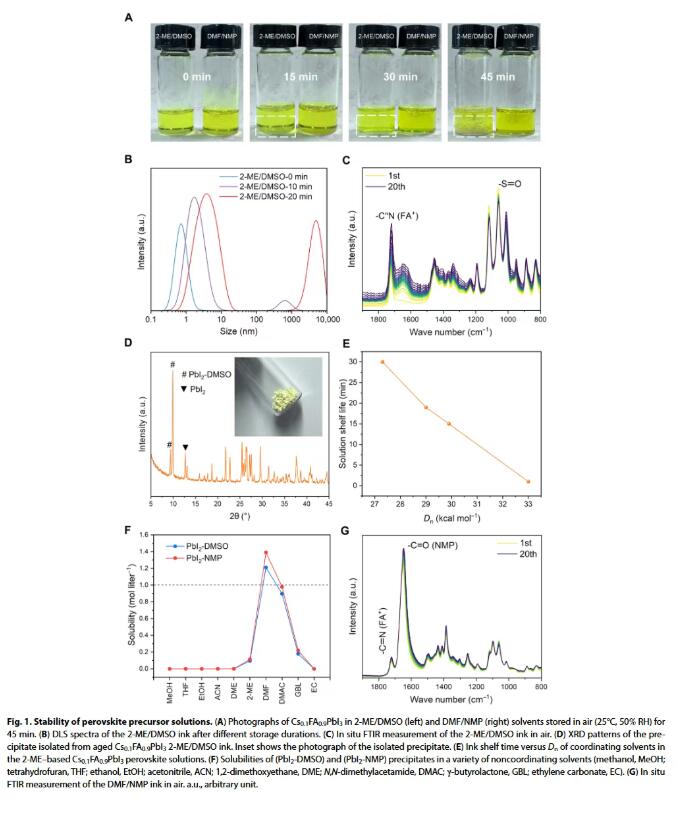
ink plays a pivotal role in determining the quality of thin films and the performance of devices, and the stability of the ink is crucial for ensuring high reproducibility of the devices. In this paper, Henry J. Snaith from the University of Oxford and Shangshang Chen from Nanjing University, among others, reveal the instability issues of current cesium-formamidinium lead triiodide (CsₓFA₁ₓPbI₃) ink. The aggregation and precipitation trends of the ink stem from the overly strong solvent-lead-halide coordination. By regulating the coordination strength between precursor salts and solvents, we determined that the solvent coordination-dispersion equilibrium is the dominant factor in ink stability, and developed a perovskite
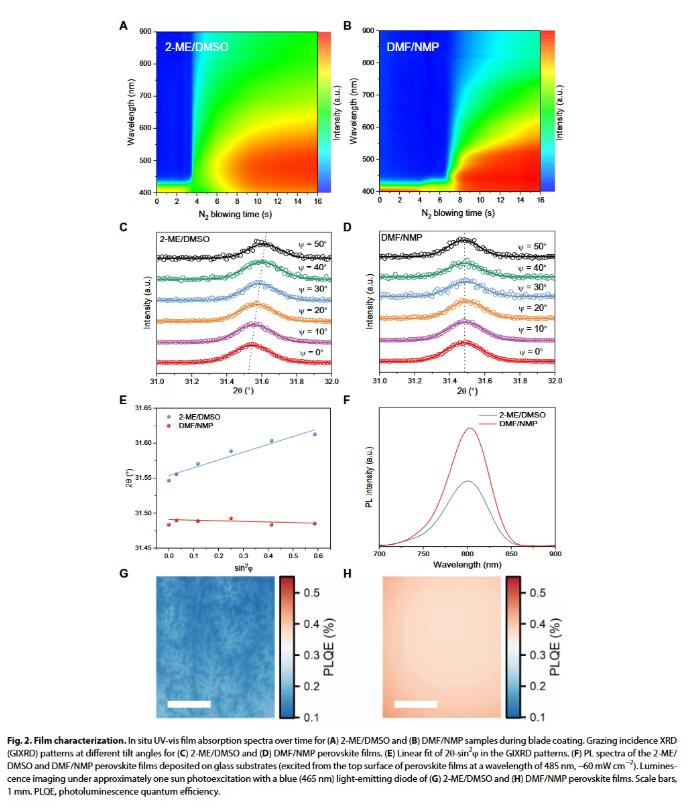
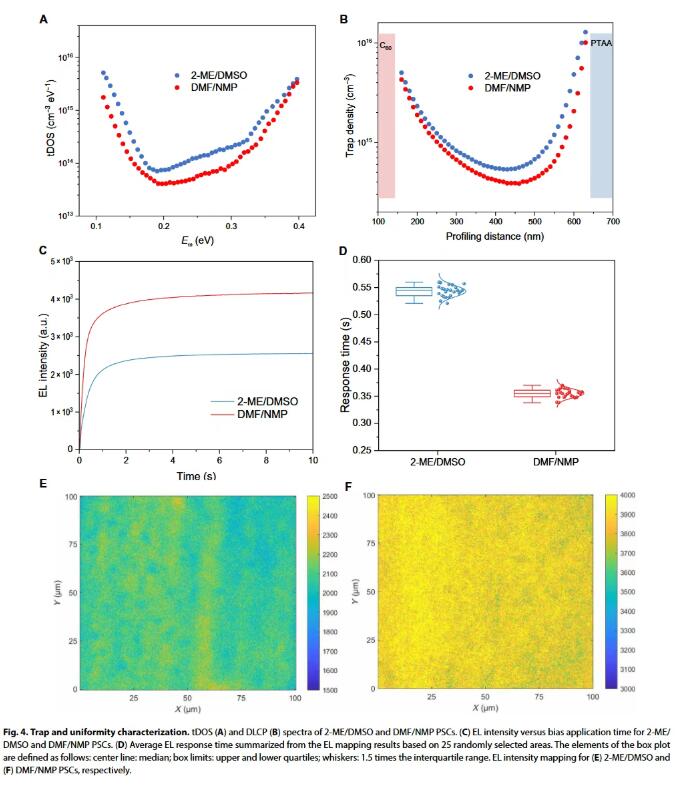
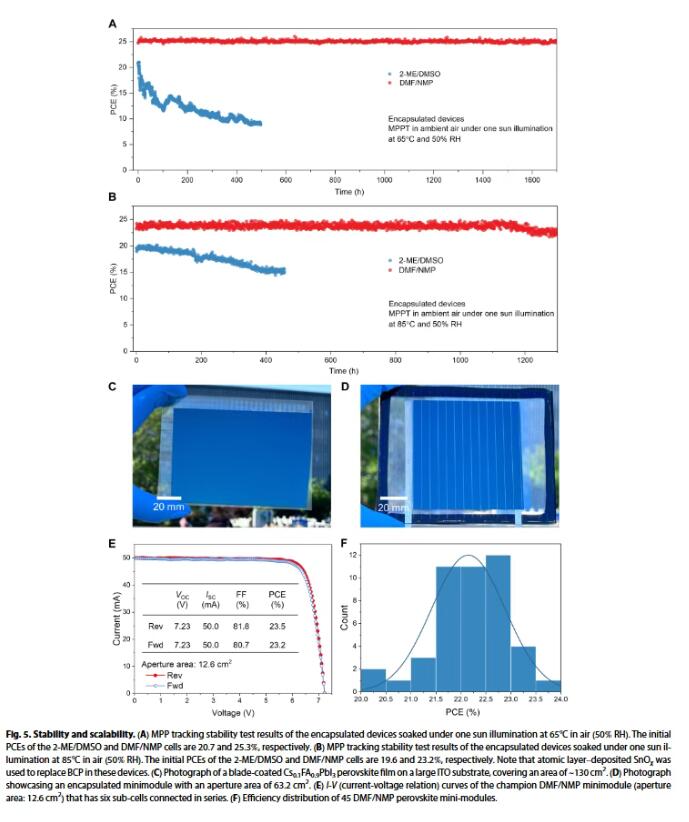
ink with significantly improved stability and extended storage life. This ink effectively regulates the drying and thin film crystallization processes, resulting in the preparation of scratch-coated perovskite thin films with excellent uniformity and low defect density. This improvement increases the aperture efficiency of p-i-n type perovskite micro-modules prepared in an air environment to 23.5%.
Research highlights
Revealing the mechanism of ink destabilization and proposing new stabilization strategies: The study found that in the traditional 2-methoxyethanol (2-ME)/dimethyl sulfoxide (DMSO) solvent system, the strong coordination interaction between DMSO and Pb²⁺ leads to the precipitation of PbI₂-DMSO complexes, which is the main reason for the rapid destabilization of the ink (<15 minutes). The innovative proposal and verification of "solvent coordination-dispersion equilibrium" as the key to controlling ink stability provide a theoretical basis for designing stable inks.
Developing ultra-high stability DMF/NMP perovskite ink: Based on the aforementioned mechanism, a combination of N-methyl-2-pyrrolidone (NMP) with moderate coordination strength and N,N-dimethylformamide (DMF) with high solubility was selected to develop a novel CsFA-based perovskite ink. This ink exhibits a storage life of over 10,000 minutes in air, significantly enhancing process tolerance and repeatability, and overcoming the bottleneck of rapid degradation of ink during large-scale preparation.
Achieving high efficiency and high stability in large-area device fabrication: The perovskite thin films prepared by blade coating with this stable ink in ambient air exhibit high quality, few defects, and good uniformity. Based on this, the p-i-n type perovskite solar cell achieves a maximum efficiency of 26.05% (certified), and the aperture efficiency of micro-modules reaches 23.5% (certified at 22.84%). After the encapsulated device undergoes MPPT tracking under continuous illumination at 65°C for 1700 hours, the efficiency retention rate remains as high as 99%, demonstrating excellent operational stability.
Yangyang Liu et al. ,Stabilized perovskite ink for scalable coating enables high-efficiency perovskite modules.Sci. Adv.12,eaec0915(2026).DOI:10.1126/sciadv.aec0915
 E-mail: info@chemborun.com
 Tel: +86-574-87178138
  No. 1558, Jiangnan Road,, Ningbo, Zhejiang, China (Mainland)/31